

Forrest Black‘s impact on the gothic internet can not be overstated. Born in a house with 13 black cats, Forrest Black’s design sensibilities have always been gothic. Writing for tech magazines in his teens, he was early to the internet and immediately started creating gothic sites with all the bells and whistles including goth-industrial streaming radio. His designs dating from the 90s were covered in such diverse press outlets as MTV and the prestigious trade publication PRINT Magazine. His early web design work influenced the structure of what eventually became blogs. He applied his Masters in project management from George Washington University and undergraduate computer science study to making cool projects. As CTO and creative director of the wildly popular Blue Blood Magazine and associated subculture membership sites, his work inspired and popularized alternative aesthetics of the time. Not seeing exactly the sort of celebratory and beautiful images of our gothic community that he wanted to design with, he picked up the camera. As a tech innovator and pioneering visual artist, he has been incredibly influential in moving goth media forward. Mick Mercer, the world’s foremost goth writer on music, once opined that Forrest Black is who he would crown the King of Goth.
With his partner Amelia G, Forrest Black is Gothic Beauty’s second most published photographer. He has contributed fashion photography of Azrael’s Accomplice, DivaLuxe, Isabella Costumiere, Jeannie Nitro, LashyDoodle, Retailslut, Shrine, Subculture Array, Syren, Vampire Technology, Versatile, and more. Gothic Beauty Magazine has published his photographs of Alicia Gorecki, Angel, Anita Fix, Batty, Bill Rieflin, Calla, Daizy Cooper, Damon Knight, Dana Dark, Dani Divine, Debra Fogarty, Deven Merkel, Diva Luxotica, Domiana, Eddylicious, Emma, Evelyne Bennu, Fetus de Milo, Galaxina Vox, Halloween Jen, Janna James, Jeffrey Damnit, Jenn Skott, Lori the Gory, Lydia Black, Malice McMunn, Merrydeath, Natalie Banana, Penny Poison, Persephone, Peter Thomas, Requiem in Black, Roman, Sascha Konietzko, Sharon Destruction, Syber Kitty, Szandora, Tim Skold, Twiggy, Veronica O, Verotika, Yolanda, and more. In recent years, he has also written for Gothic Beauty Magazine about Alchemy of England, Apres, Culte du Cuir, Deadly Bombshells, Demonia, FootClothes, Foxblood, Haunted Hair, Holo Taco, Just Buried, Kreepsville, Kuromi, Lilachris, Lip Service, Lively Ghosts, Micheline Pitt, Nekoyanin, Shipwreck Supply Co, Romand, YRU Shoes, Vinca, and more. He modeled the Apres Nail Kuromi drop in Gothic Beauty Magazine 57.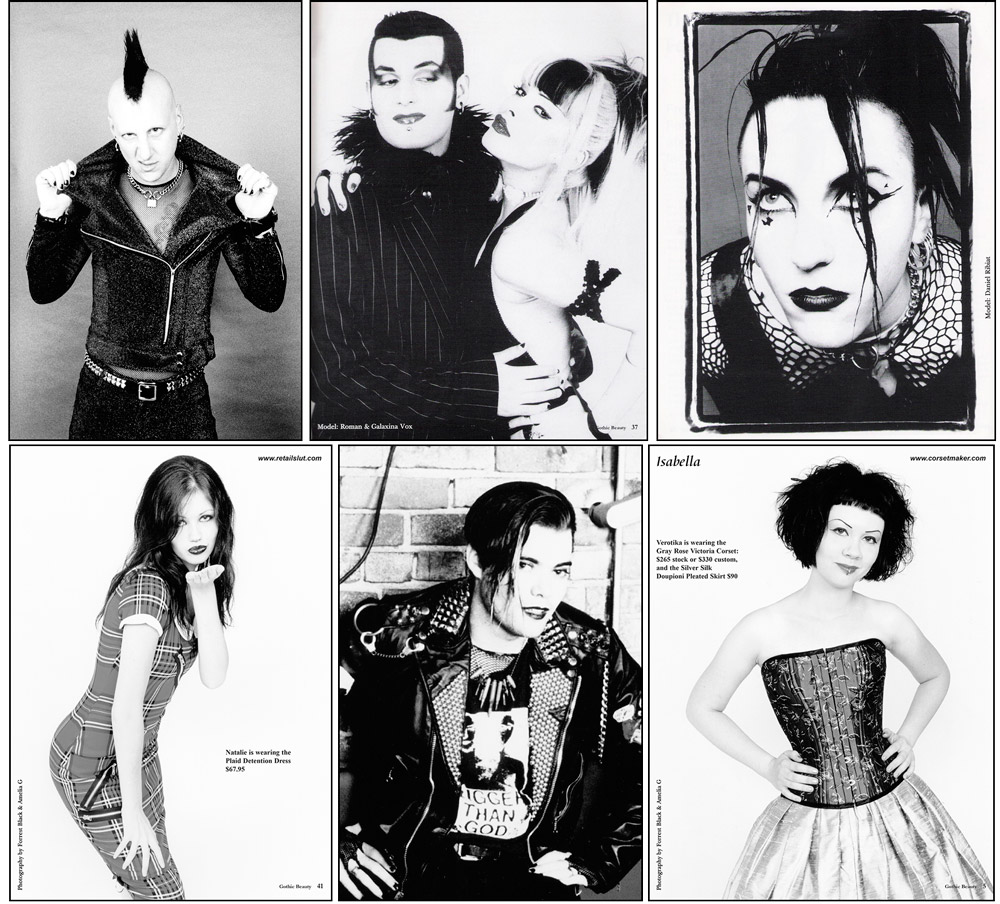
We are thinking of including one of his and Amelia G‘s photos created with Batty, wearing DivaLuxe and Azrael’s Accomplice, in the retrospective calendar currently funding on Kickstarter. If you pledge the Gothic Beauty Kickstarter project, you can help curate which images we publish. I am very excited about getting to interview such icons of our community. Excerpts of this interview series will be included in the Gothic Beauty 25 Year Reunion of Original Artists – Calendar Project, but I wanted to share the full-length interviews as well.
BTS: How did this particular shoot for Gothic Beauty Magazine 5 come together and what was the shoot day like? Anything you’d like to share about the location, how the collaboration went, what it was like working with your collaborators, anything extra you had to do to make the shoot happen? What was the post-processing like and has your process changed/evolved since then?
Back then, we were shooting on film, with a mechanical Canon F-1 and doing our own color darkroom work, so we had a lot of control over the final look. Since then, the film, the paper, and probably the darkroom machines have all been discontinued, so yes, things have changed a lot. Honestly though, to me, that’s when it felt the most artistic. There is still a lot of creativity that goes into modern photography, but there was something more primal about working with physical geared machines, hand printing pictures with enlargers, dodging and burning with bits of cardboard, and having to breath all those nasty toxic chemicals, just to see your unique print come off the rollers at the end. I believe the image of Batty that ran on the cover of Gothic Beauty #5 was also cross processed, which added another layer of complexity.
The way that shoot came together was a bit of an adventure as well. Houston Texas had a vibrant Gothic and alternative scene and Amelia and I had gotten some mail about a big Gothic Pageant event they were doing at a club called Numbers. Additionally, a bunch of stylish cool folks in that area had expressed interest in shooting some artistic stuff for Blue Blood. Batty was (and is) a talented seamstress and clothing designer and she made these amazing big ball gown creations, as well as a lot of other Gothy stuff. So, we packed up the gear, took a trip down to Houston, crashed at Dana Dark’s haunted little place and shot as many cool things as we could. Batty rounded up some of her friends to model her creations and some good times were had, with a little bit of mischief as well. A lot of work I still love came from that trip.
Given that your work helped define the 2000’s gothic aesthetic, what are your thoughts on the ways the culture and its art have evolved?
I think it’s nearly inconceivable to the younger generations, just what the world was like in the 90’s and early 2000’s. There were no social media sites, no cell phones like we have today, barely a burgeoning internet, so if you found other cool people, you automatically had a connection. Your best option was to find a zine at the record store, so you could learn about the culture and the music and the history. These days, the scene has matured, in some regards, but also gotten trivialized and sadly factionalized. I also think there are a lot of artificial things being injected into the modern culture that serve no positive purpose and really distract from it’s core creative identity, but that’s probably the evolution of all subculture over time, especially counter-culture. But, there are still great examples of amazing artistic expression and we have to remind ourselves to focus on and appreciate those things and not get distracted by nonsense drama and turmoil. But yes, back then (and not to be too up-hill-in-the-snow-barefoot about it) if you were making the sacrifice to express yourself as Goth or Punk or Darkwave or whatever, you really had to mean it, and I miss that authenticity and sense of solidarity. That spirit and presentation is what we tried to capture on film.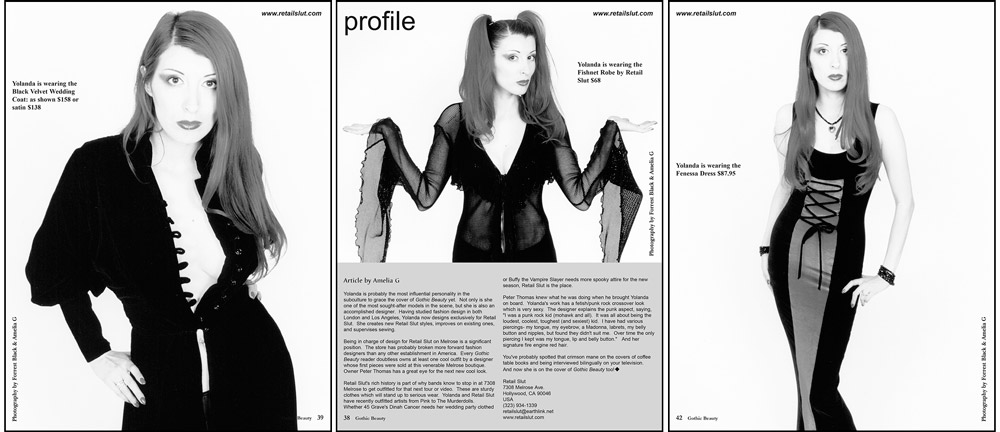
Obviously your work from this time period is iconic, but, from your perspective, where were you at in your career at the time?
That was honestly a bit of a weird time for us. Amelia G and I had been doing punk rock zines, like BLT (Black Leather Times), and later Blue Blood magazine since the very early 90’s, so to us, magazines like Gothic Beauty were nearly a generation behind. But, for context, we didn’t start out as photographers, that was just a necessary skill to add in order to do better publications. Around the time Gothic Beauty started (and the internet, etc.) was the time that Amelia and I had recently branched out and began shooting photos for magazines that weren’t our own. The only money in it was from adult work and maybe a bit from some of the tattoo magazines, which were pretty big back then. Occasionally there would be a rock magazine opportunity, but for the most part, we just shot what we wanted and then tried to figure out how to get it seen, many times at great sacrifice. You can kind of see this in our California Deathrock book (which we launched on Kickstarter, many years ago) which is full of portraits we took at dirty little hole-in-the-wall dive bars, crammed behind pool tables or whatever. The pictures are real, in the moment, beautiful, flaws and all. I remember someone over at Wired magazine wrote some critical static about a picture we shot of a friend, apparently her eyebrows were offensively jacked up or somesuch, and I’m like, she lives under a f’n bridge you entitled snob. But, back to the point, Amelia and I shoot as a team, always have, and despite our inclination to be straight up artists about it all, we have had some commercial success, and back in those days, magazines actually did pay money. I guess it depends on how you quantify your career goals. We came out of magazines, so we understood what worked best for them, so we got published a lot, and in my mind, that was being successful.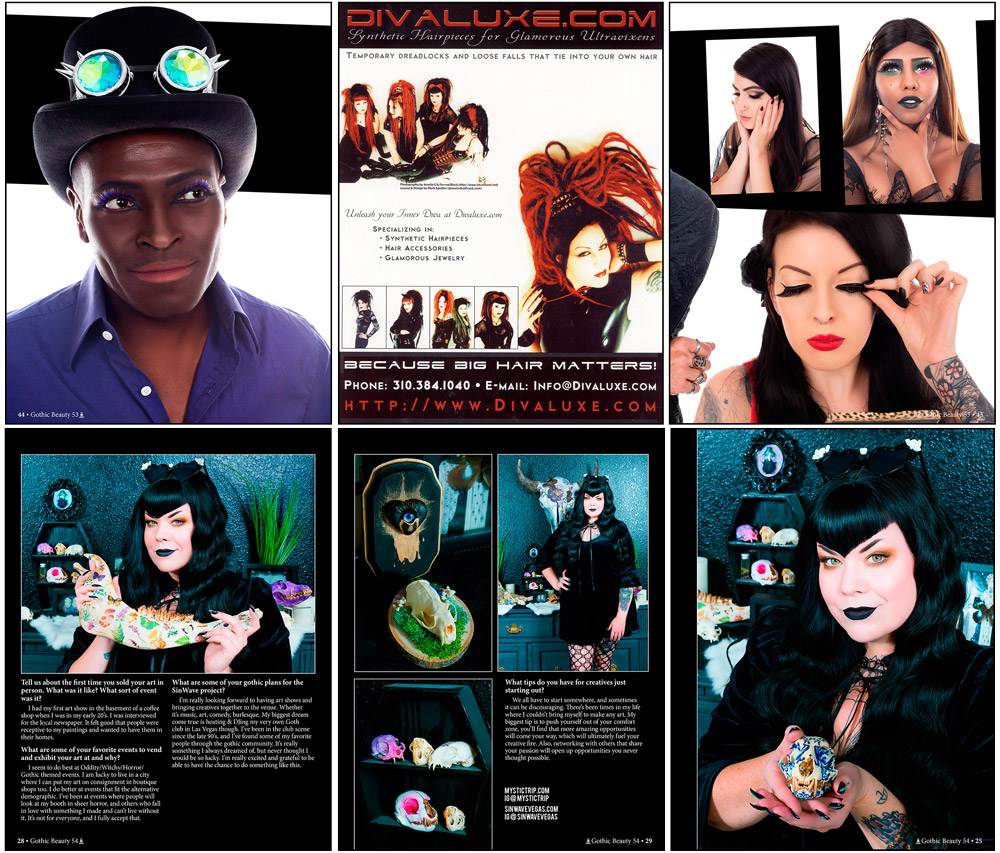
What are some of your credits (publications, clients, subjects)?
We’ve shot for Rolling Stone, Skin Two, Marquis, Alternative Press, Bizarre, Burrn! (Japan), Marquis, MTV, Permission, Picture, AltStar, Secret, Sonic Seducer, Star Magazine, Tattoo Savage, Zillo, nearly every classic Gothic magazine you can think of, Ascension, DeathRock, Draculina, Drop Dead, Ghastly, Gothic Beauty (obviously), Juggernaut, Lollipop, Meltdown, Metal Edge, New Grave, New Rave, Orkus, SWAG, and many more. That’s about half of them anyway.
If you have like a standard bio you use, please send it over, but totally fine if you do not.
I don’t. I should, but I’m not that good at that sort of thing.
Facebook @ForrestBlack
X/Twitter @ForrestBlack
Instagram @wildfleshphoto and @23blackcats
TikTok @23blackcats

The Gothic Beauty reunion retrospective Project is on Kickstarter until December 11.