
- 0shares
- Facebook0
- Twitter0
- Pinterest0
- Reddit0
- 0
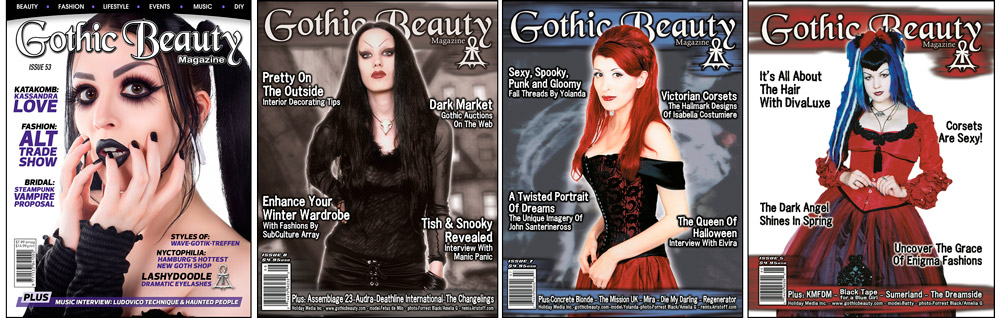
Amelia G is one of the most significant multimedia figures from the American goth scene of the 90s and early 2000s. As founder of the wildly popular Blue Blood Magazine and associated subculture membership sites, her work inspired and popularized alternative aesthetics of the time. She brought a certain academic rigor to writing about our scene and those who create within our community. She holds a Masters from University of Michigan and a BA from Wesleyan University in social psychology and English with a focus on the evolution of literature, and wrote her honors thesis on vampires. An editor, writer, and photographer, her journalistic sense of story helped define the early voice of Gothic Beauty Magazine and she still contributes writing and photography and consults on fulfillment and distribution today.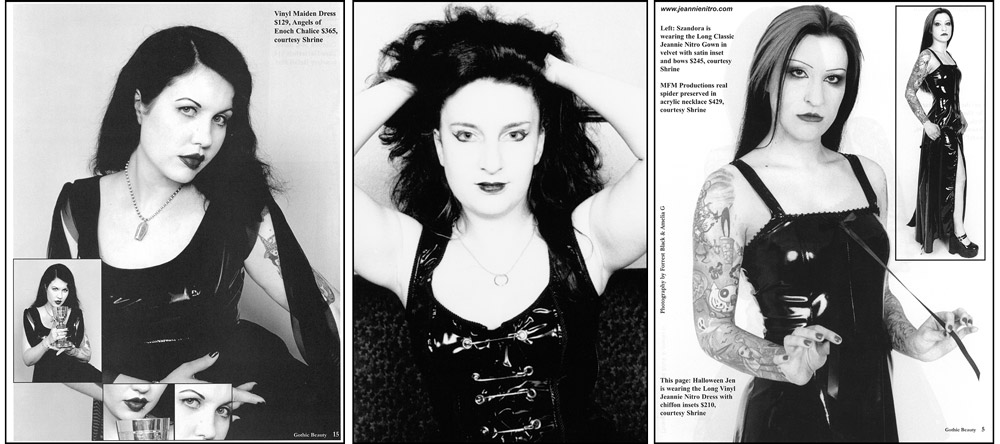
Amelia G is one of Gothic Beauty’s most published writers and, with her partner Forrest Black, she is Gothic Beauty’s second most published photographer. Amelia G’s business card says simply, “I make things happen” and this is true. A funny behind-the-scenes story of how relentless and how dependable she is: Early on, Gothic Beauty assigned her a feature on the clothing designer Jeannie Nitro. This was at a time before social media was really a thing, so the only info available was that Gothic Beauty liked the Jeannie Nitro Bone Church PVC and velveteen black and red flowing designs, but, unbeknownst to Gothic Beauty, Jeannie Nitro was on hiatus at the time. So, without mentioning any challenges, Amelia G went to Melrose, one of the epicenters of alternative fashion at the time, and set up to pull Jeannie Nitro outfits from her friends at infuential shops Retailslut and Shrine; she and Forrest Black photographed models in the outfits; and she delivered an article and feature photo layout on deadline and one of the photos even ended up being perfect for the cover.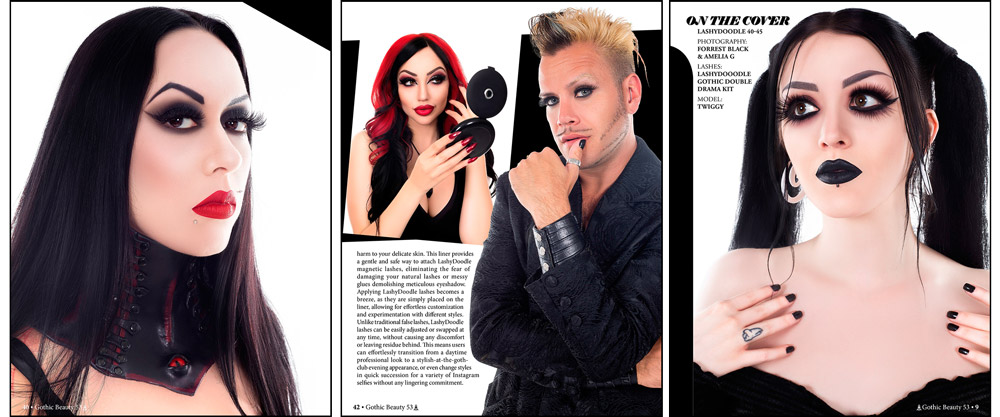
Additional fashion designers Amelia G has contributed writing and/or photography to Gothic Beauty on include Vampire Technology, LashyDoodle, Lip Service, Elysian Atelier, Subculture Array, Syren, Isabella Costumiere, Versatile, and more. Gothic Beauty has published her photographs of Dana Dark, Dani Divine, Yolanda, Fetus de Milo, Janna James, Merrydeath, Twiggy, Jeffrey Damnit, Veronica O, Emma, Diva Luxotica, Requiem in Black, Natalie Banana, Sharon Destruction, Verotika, Domiana, Persephone, Syber Kitty, Roman, Galaxina Vox, Anita Fix, Eddylicious, Lori the Gory, Peter Thomas, Calla, Jenn Skott, Angel, Deven Merkel, Evelyne Bennu, Alicia Gorecki, Lydia Black, Penny Poison, Malice McMunn, Damon Knight, Daizy Cooper, Sascha Konietzko, Tim Skold, Bill Rieflin, Debra Fogarty, Halloween Jen, and more.
Having contributed to thousands of pages of editorial for varied venues, including dozens of magazine covers, her award-winning photography and writing spans many subcultures and publications from Rolling Stone to Simon & Schuster to a whole host of publications probably not appropriate to mention here. Her personal work includes the California Deathrock art book of subculture portrait photography and the 400+ page Black Leather Times Punk Humor and Social Critique from the Zine Revolution retrospective.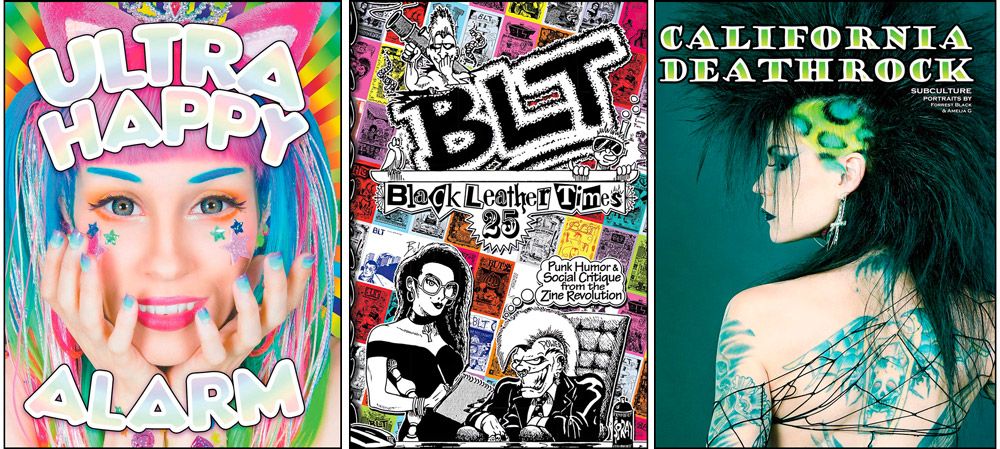
We are thinking of including one of her and Forrest Black‘s photos created with Batty, wearing DivaLuxe and Azrael’s Accomplice, in the retrospective calendar currently funding on Kickstarter. If you pledge the Gothic Beauty Kickstarter project, you can help curate which images we publish. I am very excited about getting to interview such icons of our community. Excerpts of this interview series will be included in the Gothic Beauty 25 Year Reunion of Original Artists – Calendar Project, but I wanted to share the full-length interviews as well.
BTS: How did this particular shoot for Gothic Beauty Magazine 5 come together and what was the shoot day like? Anything you’d like to share about the location, how the collaboration went, what it was like working with your collaborators, anything extra you had to do to make the shoot happen? What was the post-processing like and has your process changed/evolved since then?
In the 1990’s, I edited Blue Blood Magazine. This beautiful event promoter named Dana Dark wrote to Blue Blood. Because the magazine was focused on couples, there wasn’t really a spot for her there, but we got to talking and became friends. Forrest Black and I ended up, for a while, flying every year to Houston, Texas to work with her and act as judges in her and her partner Mina Bell’s Gothic Beauty Pageant. At the time, Forrest and I were shooting almost exclusively on film. We had purchased our first digital camera, but only $20k Hasselblad backs made big enough images to look really good in print at that time. Because we were shooting on film and every push of the shutter was expensive, we shot with great intentionality. We did our own color darkroom printing (I do not miss those toxic chemicals) and sent prints off to magazines. With no retouching stage, everything had to be perfect at the time of shooting.
Anyway, the Gothic Beauty Pageant was at a nightclub called Numbers and Forrest and I set up a location studio there. We shot attendees we found most photographically interesting on both Kodak Portra VC, which got extra vibrant but realistic colors, and Fuji Provia slide film which we then cross-processed. Cross-processing was a chemical method of developing slide film so that it has super saturated hypereal colors and could be printed like a negative.
I estimate we worked with Batty, both as a model and as a designer, on ten or twelve setups, but I think I am most fond of this one. At the time, Batty and her mother (RIP) had a really cool goth clothing design company called Azrael’s Accomplice. So Batty came out that night in this incredible red custom outfit they made, topped off with blue dread falls by the talented DivaLuxe, whose promo photos Forrest and I had also shot. Batty looked amazing, so one-of-a-kind. It was my privilege to also write the DivaLuxe feature in Gothic Beauty Magazine #5 which this Batty shoot illustrated.
One of my favorite things about photography is how it can immortalize a moment. As an artist, I particularly enjoy capturing those moments where a person has that certain extra spark and style and is just on fire. The photos from that trip show star quality and style and how much those events, in those times, felt like a meeting of the tribe.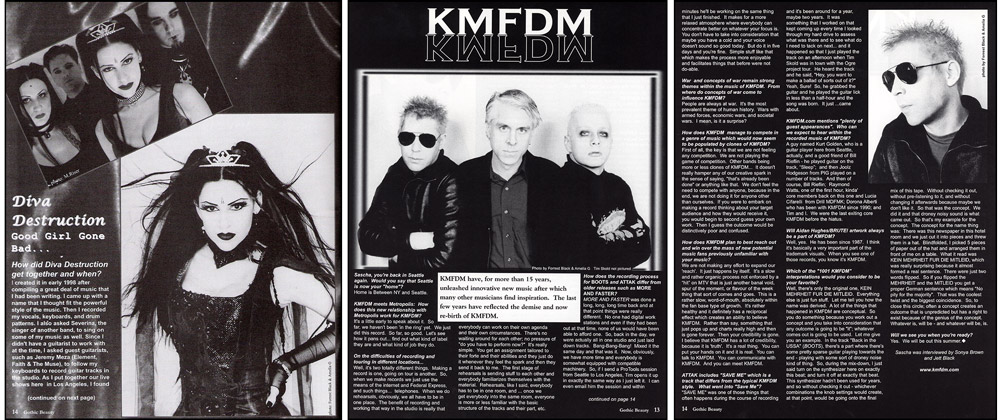
Given that your work helped define the 2000’s gothic aesthetic, what are your thoughts on the ways the culture and its art have evolved?
I remember being a teenager in the late 80’s, when I did my undergraduate degree at Wesleyan University. And it was nice to be around intelligent people and all, but I looked at MTV and I ached to climb through that screen to something that just really connected with me. It was hard to find a yellow pages and call around to find a military surplus store to get my first pair of combat boots to wear to a show at Toad’s Place. The most flamboyant hair colors we could find tended to be natural colors that just would not typically be on the same head. Fun fact: if you dye a stripe in your forelock with 40 volume off-the-scalp bleach for enough years and you do put it on your scalp (despite the instructions), eventually your hair just makes a silver stripe there naturally. Or at least mine did. I’d find out about bands by meeting people at shows or SF cons and having them share what they enjoyed. As a music journalist and budding science fiction writer, at the time, I had a lot of fun meeting so many interesting people. The zine revolution in the early 90’s increased this exponentially for me.
In the late 90’s and early 2000’s, it was really nice to be able to go visit another city and connect with our tribe there. At the time we worked with Batty to create this image, we lived in Los Angeles, but the Houston scene felt like our people too. It was just the beginnings of us all learning how to navigate the end of the 300 mile rule; just because something happened far from home did not mean that it would not be heard about internationally via, not just magazines for the high points, but also via blogs and LiveJournal with less of an editorial focus on the positive.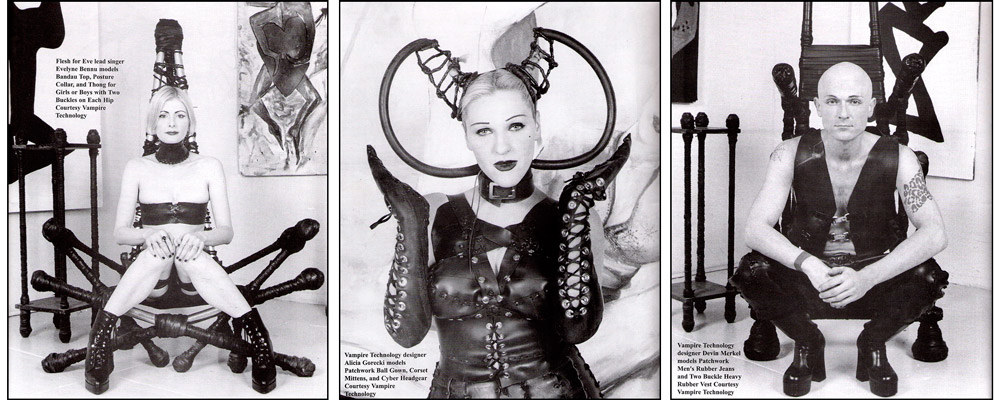
Today, if someone sees a music video on YouTube and thinks it looks cool, it just takes modest research skills to find an endless stream of TikToks with everything from suggestions of bands to check out to tutorials on how to get a trad goth makeup look. In a way, the immediate accessibility does make it feel less meaningful, like you could go down a deep rabbit hole on a subculture for a month and then go on to the next thing or, if you see someone else dressed in black at the supermarket, you might actually not have anything in common. Someone could be into kind of gothic stuff 24/7 and have zero IRL friends remotely interested in any of the same things. I think this is simultaneously freeing and isolating.
I’m a GenX alum of the zine revolution, which was so deeply from the heart. I shot on film to make art, no matter how costly or what else I went without. So I long ago came to terms with the way Millennials sometimes had a different (and sometimes, to my eyes, more frivolous or mercenary) take on things which mattered so much to me. So I ain’t mad at Gen Z or Gen Alpha for putting their own spin on some of the same things. Just the cycle of life.
What are some of your credits (publications, clients, subjects)?
A funny thing about supplying credits for a 25 year anniversary project is that I have done a few things over that time period. And contributing to early issues of Gothic Beauty Magazine was not my first rodeo. So I’m not sure which credits to share, what other people will care about. Honestly, just the question makes me feel kind of lost. I think it should make me feel thrilled at all the fun adventures I’ve been able to have, but it makes me just feel sort of tired now.
Obviously your work from this time period is iconic, but, from your perspective, where were you at in your career at the time?
At the time this shoot was published as a Gothic Beauty Magazine cover, Forrest and I had been shooting and writing for Gothic Beauty Magazine for around a year. This was our first cover for Gothic Beauty, although we would go on to shoot I think five Gothic Beauty covers total. We were still shooting whatever we artistically felt like and finding publications to publish our work once it was created. This was probably one of the most diverse and prolific time periods in our photographic work. Maybe fifteen years after my first professional writing, but very early in our professional photography. We’d pivoted from just shooting and writing for our own projects to freelancing for a very wide assortment of clients. Over a maybe three year time period, we shot around 1,500 people and it felt like, all of a sudden, every time we went to the newsstand, we were thrilled to see something we shot on the cover of yet another magazine. (Newsstands were a thing then. It was a long time ago.) It was a very exciting time to be collaborating on this type of work.
www.ameliag.com
Instagram @wildfleshphoto @realameliag

The Gothic Beauty reunion retrospective Project is on Kickstarter until December 11.